

Entering the second week of the USL Championship season, the CBA negotiations between the league and USLPA remain unresolved. The talks themselves are uncertain, and they’re increasingly colored by both sides’ public posturing and the potential impacts that could arise from a still-lingering strike.
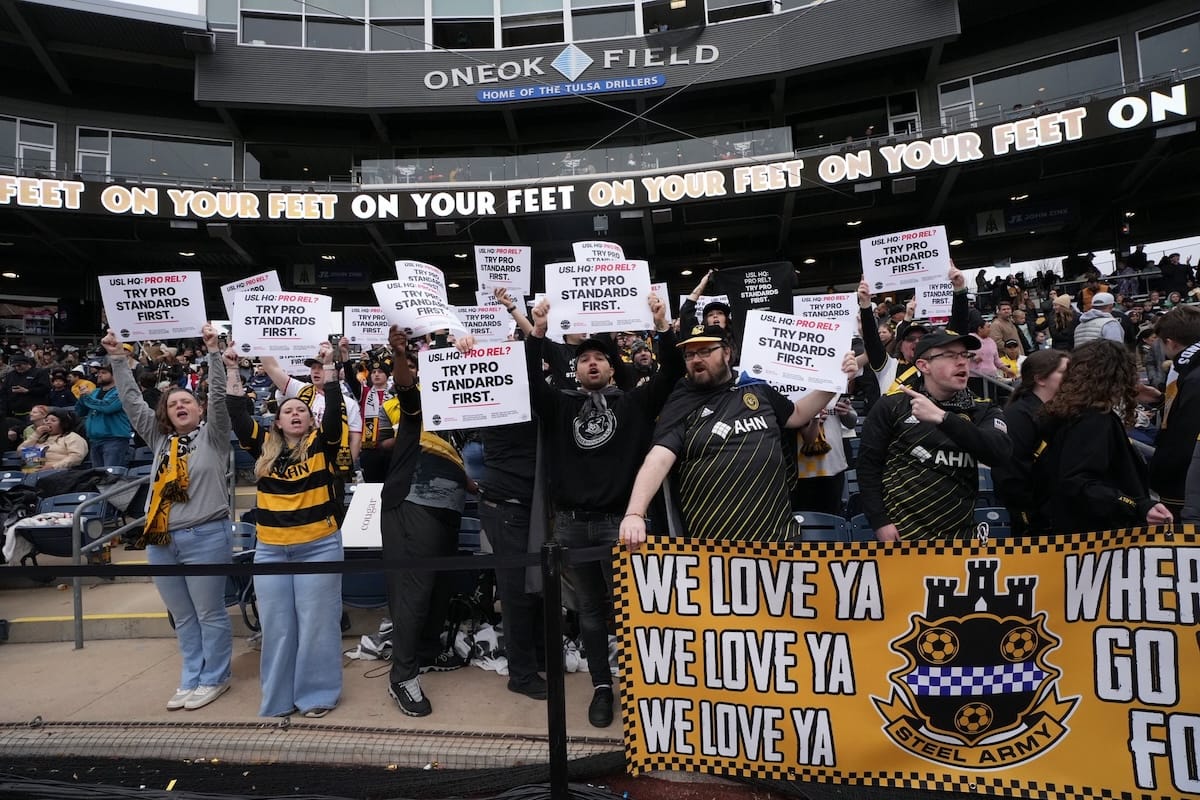
The parties met again this week, in the wake of public demonstrations by the players during the Championship’s 10-match opening weekend. Each game began with 60 seconds of stillness after kickoff, with players stoically representing their unity – and their very literal ability to stop play – across team lines. League-run broadcasts began to cut away from the demonstrations as the weekend continued, but the protests raised awareness of an ongoing labor situation for in-stadium supporters across the country.
With a CBA deal still pending, Lexington and Louisville begin the season with a minute-long moment of stillness.
— John Morrissey (@usltactics.com) 2026-03-07T00:41:12.978Z
A strike was first authorized on February 28th, when roughly 90% of participating players voted to reject the USL’s then-latest offer and empower their union’s leadership to call for a work stoppage. In the wake of that vote, the league took the unprecedented step of laying out its perspective on the talks, asserting that “public discussion has not reflected how far negotiations have progressed.”
After a meeting last Wednesday, the USL’s statement was updated to self-describe “meaningful concessions” on a number of issues. The new proposal offered minimum base compensation of $40,000 per year and dropped a demand for expanded in-season buyouts. Per GOAL, the USLPA has agreed to that number.
The league’s updated proposal added lengthened salary guarantees for players facing team contractions, a topic that’s gained renewed importance in the wake of South Georgia Tormenta’s hiatus. Tormenta dropped from USL League One’s 2026 field mere days before the season, leaving more than a dozen players with only three months of pay on exceedingly short notice. Reports indicate that the USLPA is still seeking longer-term guarantees related to healthcare and housing in the case of contraction.
Despite that relative progress, gulfs remain. The USL has pushed for the creation of entry-level contract spots for U23 players first entering the professional game – spots for which the minimum compensation would total just $28,500 a year, below the current CBA’s minimum pay when measured on a per-month basis. The players oppose such reforms.
On healthcare, the league and its clubs have committed to offer plans equivalent to those enjoyed by front-office staff members. In an echo of agreed-upon annual boosts to minimum base compensation, the USLPA is seeking “progression in plan quality after two years” – a request to which “the league has said no.”
Compensation for players’ group licensing rights remains at an impasse. The USL’s release criticized the USLPA’s continued comparisons to the PWHL’s $600,000 group licensing deal; for its part, the union noted a half-million dollar gap between the parties’ offers in response to the league statement.
That the USL turned toward public-facing bargaining on the eve of opening weekend was a change in its own right. Since as far back as the Championship’s playoff final in November, the USLPA has made a concerted effort to curry the favor of supporters and make their case in the court of public opinion. With a strike potentially nigh, USL HQ sought to save face by painting itself as the more reasonable party.
Just a day after those damage-controlling statements, however, The Guardian revealed that the USL had sent a mass email to the players with instructions on how to resign from the union and cross a potential picket line. The USLPA labelled that message as “an effort to scare players out of exercising their rights” and accused the league of union busting. The on-field demonstrations followed, garnering hundreds of thousands of online views on top of their in-venue impact.
How would a strike impact things?
The possibility of a strike continues to loom amidst reports that the parties have dismissed a federal mediator from their negotiations. Should a work stoppage occur, each party at the table – players, clubs, and league alike – would face major questions.
For players with minimal savings, especially those at the bottom end of the salary spectrum, a long-lasting strike presents a real risk. Still, Connor Tobin, executive director of the USLPA, noted in an interview with PHNX last week that the players could tap into CWA or AFL-CIO emergency funds during the course of a work stoppage. The CWA offers striking members $400 per week beginning on the 15th day of a strike – a key source of potential relief, given that the young USLPA lacks the strike reserve funds of more established unions.
For clubs whose revenues are highly dependent on in-stadium attendance, the pathway to relief is less clear. In the 2024 season, roughly 50% of Orange County SC’s total income came from ticket revenue and concessions sales only; Detroit City FC was at 42% in their 2023 season. Neither of those averages account for match-dependent sponsorship deals or in-person merchandise sales. A strike would eliminate those all-important revenue streams for clubs that are, near-unanimously, losing millions of dollars a year.
The USL itself faces long- and short-term risks from a stoppage. The 2026 season was intended to be a major growth moment for the Championship, capitalizing on the summer’s World Cup and the announcement of a future promotion-relegation model to draw new supporters to the league. Delays, rescheduling, and a loss of momentum bred by a strike would hinder the USL’s ability to execute on those aims.
Moreover, the long-term appeal of the USL and its expansion-driven model, which relies on a sales pitch of stability and financial upside for prospective owners, is potentially undercut by extended labor unrest. In that sense, the league’s turn toward public posturing reads as a message to future investors – and, perhaps, active club owners – rather than to the mass of fans.
From any angle, this is an unprecedented moment in American soccer, one with far-reaching implications for the USL’s model and the livelihoods of the league’s players. The pathway to resolution is cloudy. Major questions remain even after a deal is struck, with pro-rel and the creation of USL Premier on the doorstep.
For now, the only sure thing is that the USL Championship season remains in limbo.
Comments