League One is always changing, but it’s remarkable how little elite strikers have affected the table in 2026. This has never been a league driven by No. 9s in full, but there’s a distinct lack of a player like Karsen Henderlong, JC Obregon, or Trevor Amann that’s emerged as a powerhouse scorer. Table-topping clubs like Omaha, Madison, and Charlotte are driven by contributions from the midfield or by their larger systems; dark horses like Greenville and Corpus Christi lingering on the edge of the playoff conversation are largely in the same camp.
Maybe that’s just the way that soccer has gone, but the trend across League One has felt uniquely influential and remained so in Week 22. What else stood out across the week of matches? Let’s dig in.
Greenville’s tactical trade-off
I’ve critiqued Dave Dixon in his first season at the helm in Greenville for failing to delineate a tactical vision. I don’t think that’s quite right, at least after what we saw in Week 22. Dixon clearly wants to speed the game up with high pressure and let a technical midfield group run the show. When it works, it’s extremely fun to watch. When it doesn’t, it looks like a mess. This week’s 3-2 win over Boise and 3-3 draw against Portland landed somewhere between the two extremes.
This season, Greenville’s average possession has begun 42.9 yards upfield, the most advanced of any club in League One. They’ve attempted 11.3 pressing sequences per game and produced 0.77 high turnovers for each of those pressing plays; both marks rank second in the league. So long as the Triumph’s 5-2-3 has pinned opponents upfield, it’s been untouchable.
Unfortunately, the game isn’t played in the opposing third alone. Greenville, on average, is allowing an expected goal for every 57 final-third passes against – a dreadful mark that’s 30% leakier than the league average. There’s no other way to put it: the Triumph back line has been very bad, and their defensive midfield doesn’t provide a modicum of defense.
 John Morrissey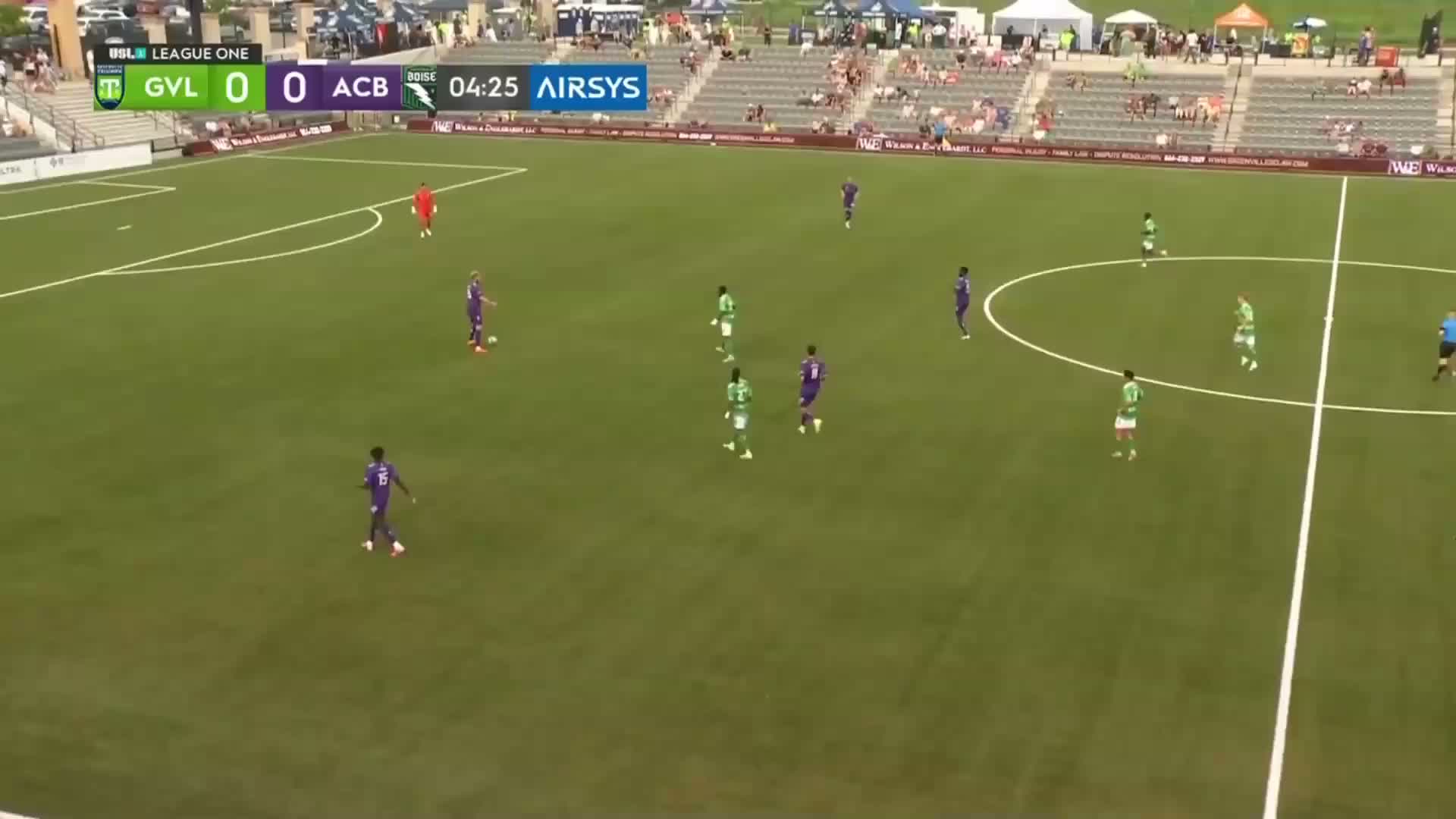
In conceding twice in the first 15 minutes against Boise, those limitations couldn’t have been more obvious. The first allowance saw Greenville’s “front five” players sliced through, forcing left-sided center back Anthony Patti out of position to cover the gap. Unable to force the ball out of play, linemates Brandon Fricke and Zane Bubb had to try and cover for Patti in rotation; the result was a gaping hole through the right halfspace that Boise cut back into.